
Call tracking for small business: see which ad made the phone ring.
Call tracking for small business shows each website visitor a phone number tied to where they came from, then credits each call to that source. For small business owners, the guesswork about which ads bring calls goes away, and you can stop paying for the ones that don't.
Book a free Revenue Leak Audit
What call tracking is and how it works
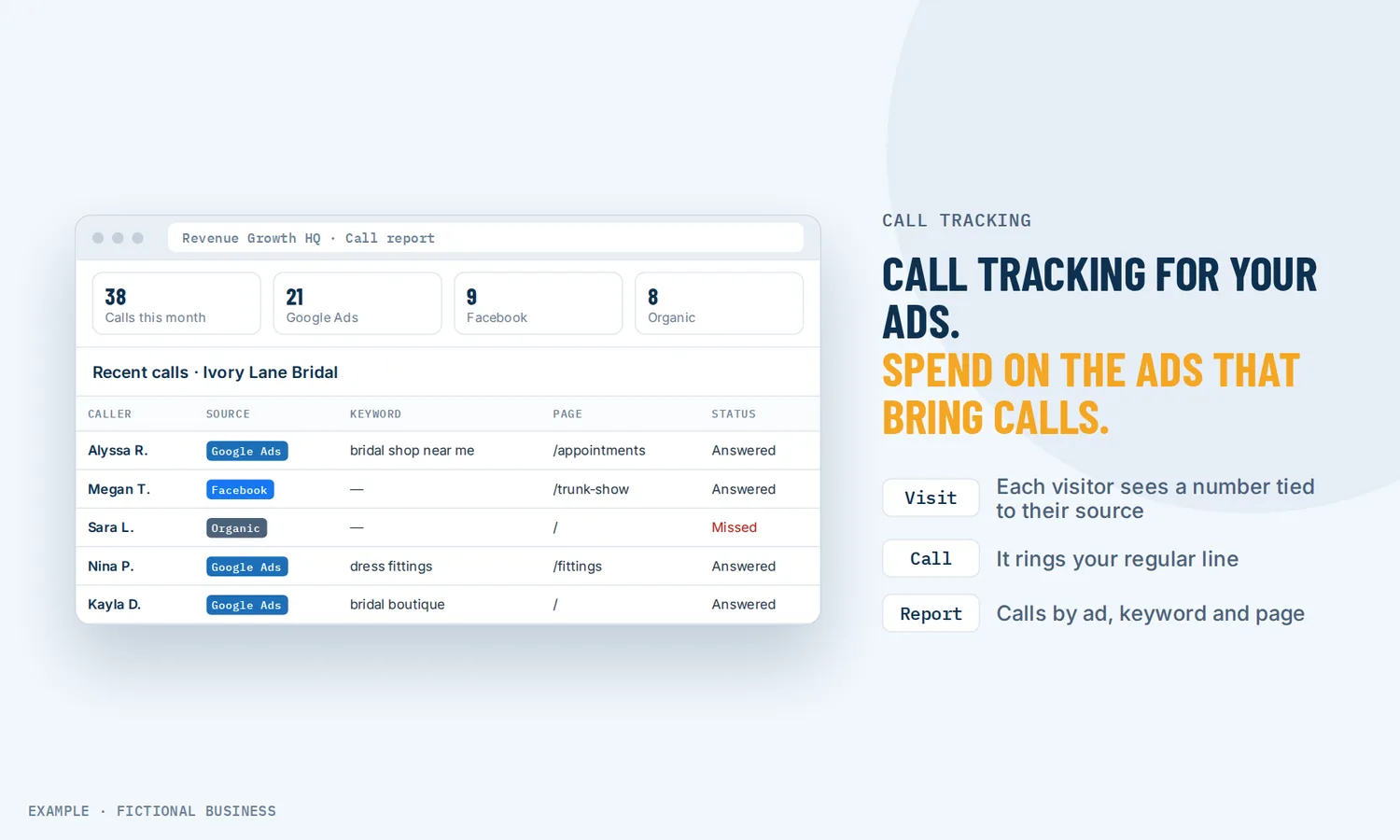
Most ad platforms count clicks and form fills well. Phone calls are harder. Someone sees your ad, visits your site, then picks up the phone, and the ad gets no credit. Call tracking closes that gap by giving each source its own number.
Here is how it works on the Revenue Growth HQ platform:
- You create a number pool. A pool is a small set of tracking numbers, at least four, that all ring your real business line. You choose local or toll-free numbers.
- You choose who sees them. Show tracking numbers to all visitors, only to visitors who arrive from a paid search ad, or to everyone except people who typed your address directly.
- You add one snippet to your website. The snippet swaps your regular number for a tracking number across your site, or on a single landing page if you prefer. Click-to-call buttons swap too.
- A visitor calls. Each visitor sees a number from the pool, and the platform remembers what brought them: the source, the landing page and, for Google Ads with a keyword tag on the ad link, the search keyword.
- The call lands in your report. The call is logged with its source on the call report and on the caller's contact record, and your phone rings as usual. An optional whisper message, heard only by you, can name the campaign before you say hello.
The industry name for step 3 is dynamic number insertion. You don't need to know the term to use it.
What call tracking changes for a small business
You stop paying for ads that don't bring calls
If most of your customers call instead of filling in a form, your ad reports leave out the part you care about most. Call tracking shows the calls each source produced, so you can compare a month of Google search ads with a month of social ads on the calls they brought in, not only the clicks. In Invoca's 2026 benchmark of more than 70 million calls, paid search drove more calls, leads and conversions than any other paid channel. Your own numbers may look different, and call tracking is how you find out.
You learn which calls turn into customers
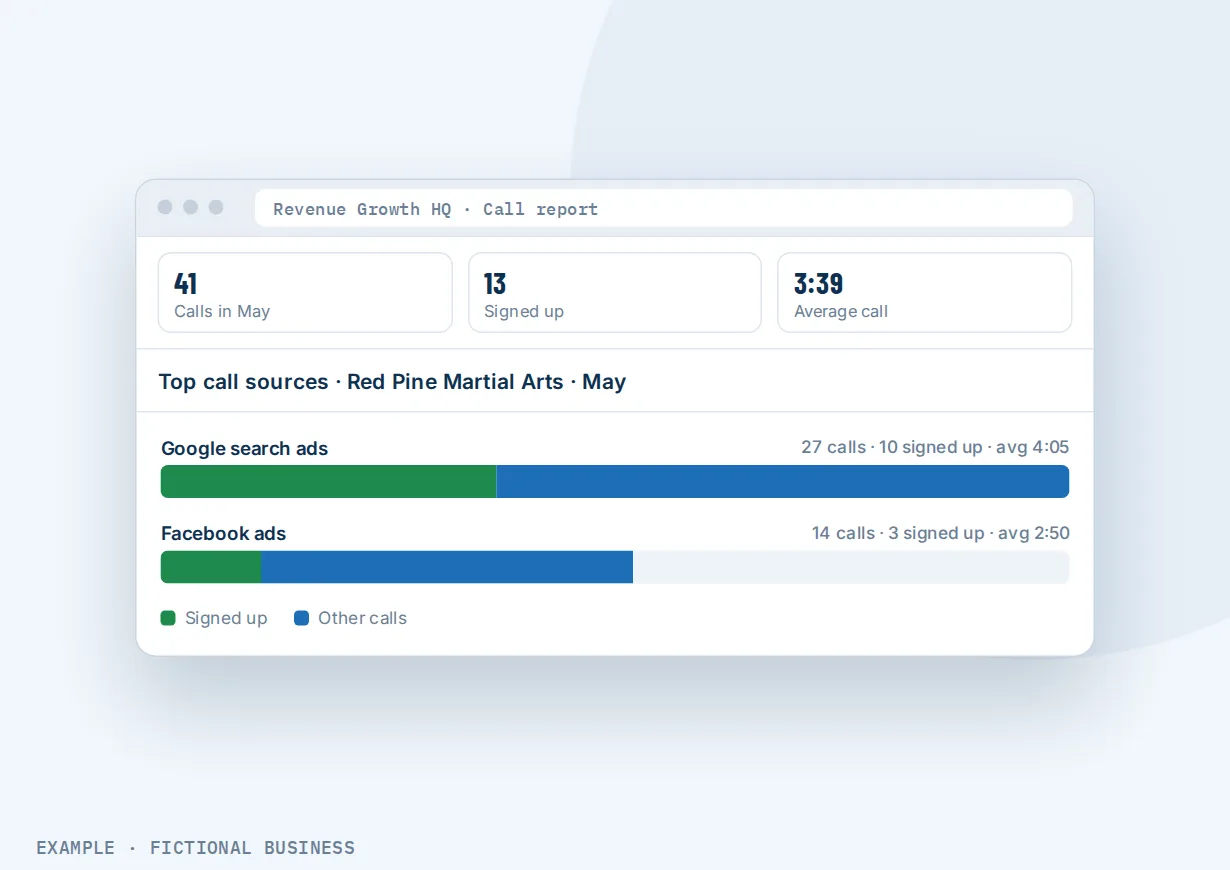
A count of calls is a start. The call report also shows the top call sources alongside deals won and call length, so a source that brings many short, unanswered or wrong-number calls stands out from one that brings fewer, longer calls that become jobs.
You see the calls you missed, by source
Many calls never reach a person. In the same Invoca benchmark, 56% of callers to businesses spoke with a person. The call report splits incoming calls into answered, missed and busy, and shows first-time callers separately. If your paid ads bring calls at times nobody is there to answer, you will see it, and you can change when the ads run or how those calls get covered.
Your follow-up knows where the caller came from
The source of the call is saved on the caller's contact record, with both the first way they found you and the most recent. A workflow can start when a call comes in through a tracking pool: tag the caller with the campaign, alert a team member, or create a callback task when the call goes unanswered. In Invoca's report, 42% of leads converted on the call itself, so a missed call can be a missed sale.
How call tracking plays out
A home service business running two kinds of ads. Let's suppose you run a plumbing business and spend on both Google search ads and Facebook ads. Both send people to the same website with the same phone number, so you can't tell which one is ringing your phone. With a number pool on the site, each visitor sees a tracking number, and at the end of the month the call report shows calls from paid search, calls from social, and how many of each turned into booked jobs. You move budget to the source that brought paying work.
A consultant testing a landing page. Let's suppose you sell consulting and build a landing page for one offer. You put the pool's snippet only on that page and show tracking numbers to everyone except direct visitors. When a prospect clicks through from a newsletter or a podcast's show notes and then calls, the call shows its source and the landing page. A workflow tags the prospect with the offer name so your follow-up email is about the right thing.
A clinic with a Google listing. Let's suppose you run a physical therapy clinic, and many new patients find you on Google Maps. You turn on call tracking for your Google listing, so calls from the listing are logged separately from calls from your website. Now you know how much your listing produces on its own, which tells you whether your work on reviews and photos is paying off.
What to look for in call tracking for small business
Questions to ask before you commit:
- Does it swap numbers on your website automatically, by traffic source, including click-to-call buttons?
- Can you choose local or toll-free numbers, and do they ring your existing phone?
- Does it capture the search keyword for Google Ads calls, not only "paid search"?
- Can you track your Google listing too, without losing your real number from the listing?
- Does the report show outcomes, such as answered vs missed and deals won, not only call counts?
- Does the call land on a contact record with its source, so you can see the customer's history?
- Can a call start your follow-up, such as a text when nobody answers or a task for your team?
- Does it offer call recording with an announcement for callers, if you want recordings for training?
- How is it priced? Ask whether you pay per tracking number and per minute, how many numbers you need, and what each costs before you start.
A standalone call tracking tool can do much of this list. The more of it you want tied to your customer records and follow-up, the more it helps to have tracking inside the same system as your contacts and messages.
Call tracking works better with your phone, listing and reports
Call tracking tells you where a call came from. What you do with that answer decides whether it saves you money.
Call tracking plus a business phone number. Pool numbers track your website. A business number for calls and texts is the line you print, text from and give to customers, and it can text back callers you missed. Both feed the same contact records, so a caller's tracked calls, texts and history sit in one place. One setup rule: pool calls ring the forwarding number you choose, and that number has to be your own phone or line, not another platform number.
Call tracking plus your Google listing. For many local businesses, the Google listing is the biggest source of calls. Call tracking for your Google listing places a platform number in the listing's main phone slot and keeps your real number as the second number, so listing calls are logged without removing your own number. If a listing call goes unanswered, it can get an automatic text back for missed calls.
Call tracking plus a reporting dashboard. The call report answers "which source brought calls?" A dashboard you build for your numbers puts calls next to appointments, deals and revenue, and can email a summary to your team, so calls are one line in the bigger picture instead of a separate report you forget to open.
Call tracking plus lead sources. Calls are one way leads arrive. Forms, chats and bookings are others. A report of leads, value and wins by source adds up all of them, so you can judge each source on everything it brought in, not only its calls.
For calls to your platform business number that you can't answer, an AI receptionist that picks up your calls can take the call, ask your questions and book an appointment. Tracking-pool calls ring your own phone instead, so the AI receptionist doesn't answer those. AI use is billed by use.
Call tracking options: from free to done-for-you
The right choice depends on how much you spend on ads, how many sources you want to compare, and how much setup you want to do yourself.
Asking "how did you hear about us?" It costs nothing and works when you remember to ask. Callers often guess or don't know, especially when they saw several of your ads before calling.
One fixed number per ad. A separate number on a flyer, a billboard or one ad is simple, and it is the only option for print and radio. Online it breaks down: one website shows one number to everyone, so calls from the website all look the same.
Standalone call tracking software. Dedicated tools swap numbers by source and report well. They are one more app and one more bill, and the calls live apart from your contact list, inbox and follow-up unless you connect them with integrations.
All-in-one platforms. Here, call tracking sits in the same system as your phone, contacts, inbox, reports and automation. A call is logged on the contact and can start follow-up without a connector. The tradeoff is more to set up, and more features than a business with one ad may need.
Hiring someone. A marketing agency can set up tracking and read the reports for you. That saves your time, but adds a fee and leaves you depending on them for changes and answers.
Here's our solution
Revenue Growth HQ is an all-in-one platform with call tracking built in, alongside your business phone number, inbox, contact records, reports, automation and AI assistants. The platform is $97 a month and call tracking is included. Usage is billed separately: each tracking number carries a monthly number fee, and calls, texts, email and AI are billed by use. You see the rates before setup. Setup is priced by how much you want done: we can set up your number pool, website snippet and reports for you, or show you how and let you do more of it yourself.
The first step is a free 20-minute Revenue Leak Audit.
Limits to know
- A pool needs at least four numbers. Each one carries its own monthly fee, so a site with little traffic still pays for four.
- It tracks visits to your website. Print, radio and vehicle signs need their own fixed number; the swap can't follow them.
- Pool calls ring one forwarding number. They can't ring the web or mobile app directly, and the forwarding number can't be another platform number.
- Recording starts when the call connects. Some states require every party's consent; turn on the recording announcement if you record.
Call tracking features included
- Number pools that swap your website number by traffic source
- Local, toll-free or any-area-code tracking numbers
- Show numbers to all visitors, paid search visitors only, or all but direct visitors
- Site-wide or single-page tracking with one snippet
- Click-to-call buttons that swap with the number
- Google Ads keyword capture
- Separate pools for different ads on one site
- Whisper message only you hear before you answer
- Optional call recording with an announcement
- Call tracking for your Google listing
- Call report with top sources, answered vs missed, first-time callers and deals won
- CSV export of call history
- First and latest source on each contact record
- Workflows started by calls to a tracking pool
Frequently asked questions
What is call tracking?
Call tracking is a way to see which marketing brought each phone call. Each source, such as a Google ad, a social ad or your Google listing, gets its own number that rings your real line. When someone calls, the number they dialed tells you where they came from, and the call is logged with that source.
How does call tracking work on a website?
A small snippet on your website swaps the phone number each visitor sees, based on how they arrived. This is called dynamic number insertion. A visitor from a paid search ad sees one number from your pool, a visitor from social sees another, and the platform credits each call to the visit that showed the number.
Will call tracking hurt my Google ranking?
For your Google listing, the platform puts the tracking number in the main phone slot and keeps your real number as the second number, rather than replacing it. The platform's own documentation says moving the real number to the second slot has not been found to hurt rankings.
How many tracking numbers do I need?
A number pool needs at least four numbers, and four to eight is typical. A larger pool costs more per month, so size it to your traffic and call volume: start small and add numbers if your calls grow.
Can I record calls?
Yes. Call recording can be turned on for tracking numbers, and an announcement can tell callers the call may be recorded. Recording laws differ by state, and some require every party's consent, so check the rules where you and your callers are before you switch it on.
Does call tracking work for flyers, radio or billboards?
Not the website kind. Swapping only works on web pages carrying the snippet. For offline ads, give each one its own fixed number from the platform, and calls to that number show up in your call report like any other call.
What does call tracking cost?
Call tracking is included in the $97-a-month Revenue Growth HQ plan. Each tracking number carries a monthly number fee, and call minutes are billed by use, so your cost depends on the size of your pool and how many calls you get. You see the rates before setup, and setup is priced by how much you want done.
Find out which of your ads ring the phone: book your free Revenue Leak Audit.
In a free 20-minute call, we'll look at where your calls and leads come from today, and where money spent on ads may be slipping away.
Sources
- Invoca. "The Invoca Lead Conversion Benchmarks Report 2026." July 2026. https://www.invoca.com/reports/the-invoca-lead-conversion-benchmarks-report-2026 (checked 2026-10-18)