
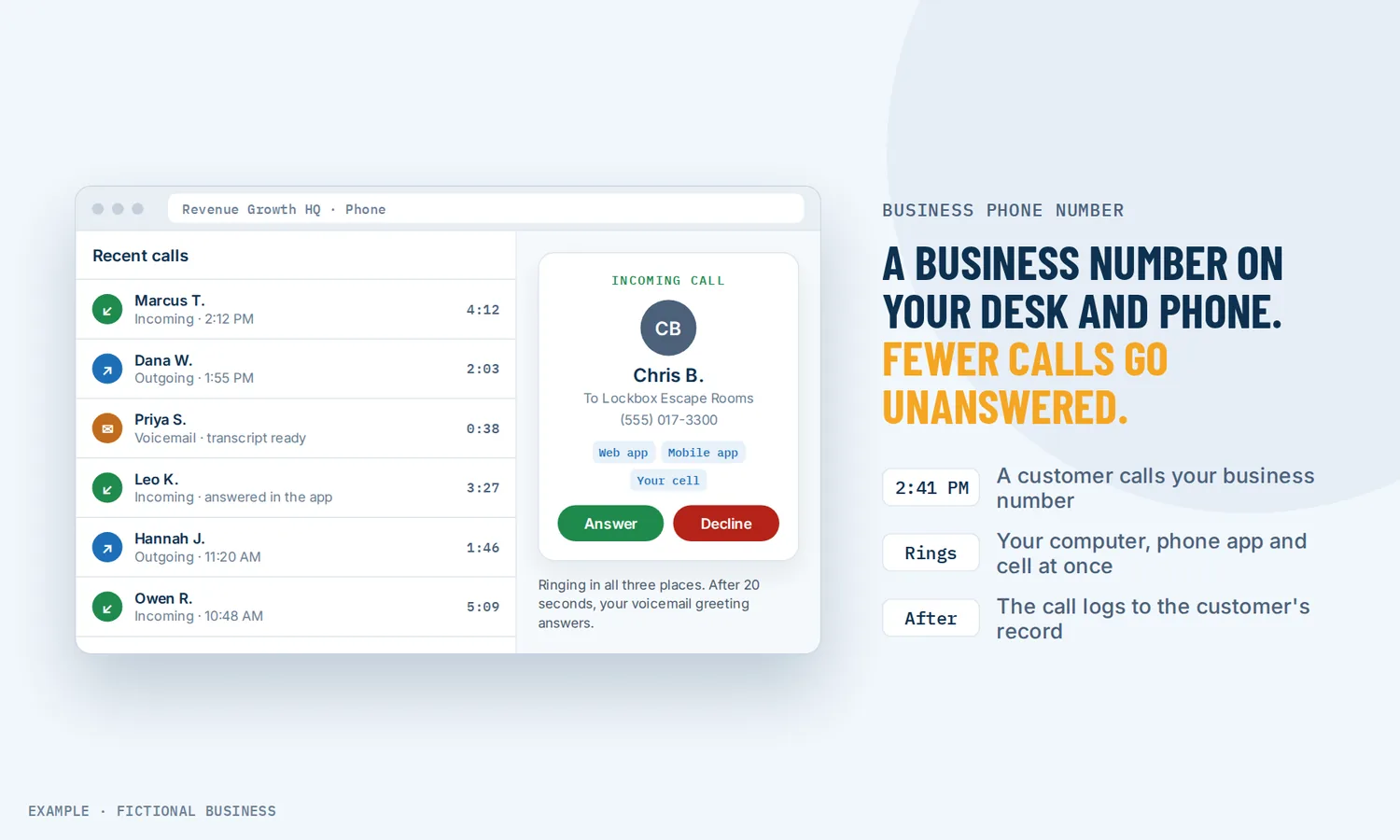
Business phone number: one line customers call, answered from your desk, your phone app or your cell.
A business phone number is a local or toll-free number that belongs to your business instead of your personal cell. Customers call it, and you answer on your computer, in the phone app, or on a phone you forward it to. Each call is logged on the customer's record next to their texts, bookings and payments.
Choose 3 setups for us to build
What a business phone number is and how it works
A business phone number works like a second line. It isn't tied to one handset, so it can ring wherever you want it to ring. Here is how it works on the Revenue Growth HQ platform:
- You pick a number. Choose a local number by area code, or a toll-free number. If customers already know your current number, you can move it over instead (US numbers; it takes a few weeks, covered below).
- You decide where calls ring. The same call can ring at once in your web browser, in the phone app, on your cell or another phone, and on a desk phone. You can also ring one main teammate plus up to six more together, and the first one to pick up gets the call.
- You set what happens when nobody answers. After a set number of seconds, the call goes to your own voicemail greeting or to an AI voice agent. Callers can also get a phone menu ("Press 1 for sales, press 2 for service").
- You call out from the business number. Click a contact or dial in your browser. Depending on your access, you pick which business number the customer sees, or you call from the number assigned to you. The phone app can start calls too.
- Every call lands on the record. Time, length and status save to the customer's contact, with the voicemail and a written transcript if you turn transcription on.
What a business phone number changes for a small business
Your personal cell stays personal
When customers have your cell number, work follows you everywhere, and the number leaves with whoever holds the phone. A business number separates the two. You choose when it rings on your cell, and when it rings only on the computer at the shop. If you sell the business or hand the phones to an employee, the number and the call history stay with the business.
Calls reach a person, not one pocket
A call to one person's cell is answered only if that person is free. A business number can ring the office computer, a teammate's phone app and your cell at the same time, so whoever is free picks up. When nobody can, the call goes to your own voicemail greeting after the ring time you set, and the voicemail shows up in the same place as the rest of your calls.
Customers recognize who is calling back
People screen calls. In a 2020 Pew Research Center survey, 80% of U.S. adults said they don't generally answer cellphone calls from unknown numbers. When you return calls from the same business number customers dialed, and that number appears on your website, invoices and texts, your callback is easier to recognize. When they still don't pick up, leave a message: in the same survey, 67% said they don't answer unknown numbers but do check a voicemail if one is left.
A record of every call
Each call saves to the customer's contact, next to their texts, emails, bookings and payments. Before you call someone back, you can see when they last called, how long you talked, and what they booked. The Recent Calls list shows incoming and outgoing calls, so a missed one is easy to spot and redial.
How it plays out
A home service business. Let's suppose you run a plumbing business with three trucks and an office manager. The business number rings the office computer and the owner's phone app at once. The office manager answers most calls from the browser and books the job. When she is on another call, the owner can pick up from the truck. After 20 seconds with no answer, the caller hears your own voicemail greeting, and the message waits on the customer's record.
A consultant or agency. Let's suppose you sell a monthly service to other businesses and work from a laptop. You use a local number in your home area code for sales calls, and you call prospects from your browser with a headset. Calls log to each prospect's record with time and length, so your notes and follow-ups sit next to the call. When you are on a call with a client, a new caller hears your voicemail greeting after the ring time and leaves a message on their record.
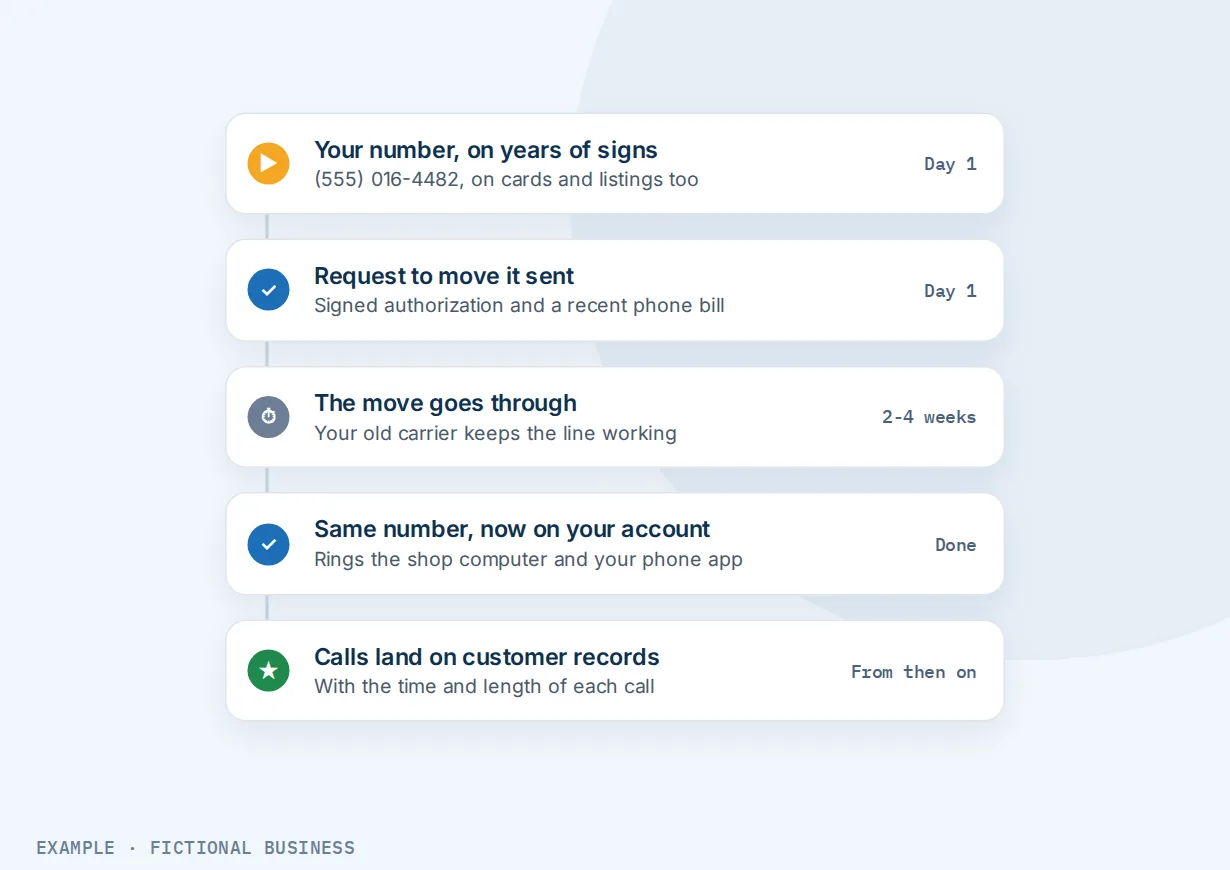
A shop with an old number. Let's suppose you run a repair shop whose number is printed on signs, invoices and years of listings. You move that number over instead of printing a new one. While the move goes through, the old carrier keeps the line working. After it finishes, the same number rings the shop computer and your phone app, and calls start landing on customer records.
What to look for in a business phone number
Questions to ask before you choose a provider:
- Local, toll-free, or the number you already have? A local number suits a business that serves one area. A toll-free number suits a business that sells across the country. Keeping your old number avoids reprinting anything, but the move takes weeks.
- Where can it ring? Look for your computer, a phone app and forwarding to your cell, ideally at the same time.
- Can your team share it? Ringing several people at once, transferring a call, and putting a caller on hold matter once more than one person answers.
- What happens when nobody answers? Your own voicemail greeting, a phone menu, or an AI voice agent beats a carrier's generic voicemail.
- Does the caller see your business number when you call out, from both the computer and the phone app?
- Are calls logged with the customer's record, or kept in a separate phone app?
- Can the same number text? Customers often text the number they called. Texting needs carrier registration, so ask how that works.
- Is recording available, with a disclosure message? Recording rules vary by state, so check the rules where you operate.
- How is it billed? Ask about the number's monthly rent, per-minute rates for incoming and outgoing calls, whether minutes round up, and what forwarding, recording and transcription add.
A business phone number works better with automation and AI
Text back callers you miss. When a call goes unanswered, the caller gets an automatic text from your business number. The conversation keeps going by text, so a missed call doesn't have to end at voicemail. It runs on its own, and you step in when they reply.
An AI voice agent that answers calls. Set an AI voice agent as the backup on your number. When nobody picks up in time, it picks up, answers common questions from what you've taught it, takes the caller's details and can book an appointment during the call. You can also set the hours it works, such as evenings and weekends. AI minutes are billed by use.
See which ad made the phone ring. Your website can show a different number depending on where a visitor came from, and each call is credited to that source. You can see which ads bring calls and cut the ones that bring only clicks.
Calls in your pocket. The phone app can ring for business calls and start calls to customers, away from the desk. The same app holds your conversations, calendar and contacts, so you can check a customer's history before you call.
Business phone number options: from free to done-for-you
Your personal cell. Free, and fine for a one-person business. Customers end up with your private number, nobody else can answer it, and the call history leaves with the phone.
A free virtual number app. Free or low-cost apps give you a second number that rings on your cell. They separate business from personal, but they usually have little or no team sharing, and the calls stay apart from your customer records.
A second-line or business phone service. Paid services add a business number with team features: shared lines, phone menus, voicemail transcripts, desk phones. They handle calls well. Your bookings, texts, payments and customer records still live in other tools, and you copy information between them.
All-in-one platforms. The number sits in the same system as your contacts, inbox, calendar, payments and workflows. A missed call can trigger a text, an unanswered call can go to an AI voice agent, and every call lands on the customer's record. The tradeoff: more to set up, and more features than a business that only wants a phone line may need.
Hiring people to answer. Front-desk staff or an answering service give callers a human voice. Staff cost wages and cover the hours they work; an answering service charges monthly or per-call fees, and its agents know only what you tell them about your business. You can also pay someone to set up any of the options above.
Here's our solution
Revenue Growth HQ is an all-in-one platform with a business phone number built in, alongside texting, online booking, payments, reviews, automation and AI. The plan is $97 a month (or $970 a year), and the phone system is part of it. The plan includes $30 of usage credit each month for your phone number, calls, texts, email and most AI features: the number's monthly rent, minutes for incoming and outgoing calls, and call recording and transcription if you turn them on. Use beyond $30 in a month is billed by use, at the same rates as buying the software directly. You see the rates before setup.
Setup is a one-time $197. You choose 3 setups from our list for us to build in your account, such as an AI phone receptionist or missed-call text back. When a choice calls or texts, we set up your business phone number and its texting registration as part of it, and with any choice we build your knowledge base from your website. See the setups and choose your 3.
Limits to know
- Moving (porting) an existing number takes weeks. US numbers only through the standard process, usually two to four weeks after the paperwork is in. Keep your old service active until the move completes. Text history from your old provider doesn't come with it.
- Minutes round up, and forwarding is billed twice. Calls bill in full minutes. A call forwarded to your cell is billed for the incoming leg and the forwarded leg.
- Browser calling needs a working microphone setup. Allow the browser to use your microphone; VPNs, some browser extensions and strict office networks can block calls.
- Calls end at two hours. A call that runs past two hours disconnects, and you call back to continue.
Business phone number features included
- Local and toll-free business numbers
- Moving your existing US number (port)
- Calls in the web browser, with no extra hardware beyond a headset or microphone
- Calls in the phone app
- Ring several teammates (each on their computer or phone app), your cell and a desk phone at the same time
- Ring up to six more teammates at once; first to answer gets the call
- Mute, hold, warm and blind transfer, keypad
- Choose which business number shows when you call out
- Custom voicemail greeting, voicemail playback and optional transcripts (billed by use)
- Ring timeout, then your voicemail or an AI voice agent as the backup
- Phone menu built as a workflow
- Call recording with an optional disclosure message (billed by use)
- Call scripts on screen during a call
- Every call logged on the customer's record, plus a Recent Calls list
Frequently asked questions
What is a business phone number?
A business phone number is a phone number that belongs to your business, not to one person's cell. It can be local or toll-free. Customers call it, and it rings wherever you set it to: your computer, a phone app, your cell or a teammate. Calls you make from it show the business number to the customer.
How do I get a business phone number?
Pick a provider, choose a local number by area code or a toll-free number, and set where calls ring. On Revenue Growth HQ, you pick a new number by area code from the phone settings. Texting on that number needs carrier registration first.
Can I keep my existing business phone number?
Usually, yes, for US numbers. You sign a letter of authorization and send a recent phone bill, and a cell number also needs the PIN from your carrier. The move usually takes two to four weeks after the paperwork is in. Keep your old service active until it completes. Text history from the old provider doesn't transfer.
Can I answer business calls on my cell phone?
Yes, two ways. The phone app can ring for business calls, and you can start calls from it. Or the number can forward calls to your cell, ringing at the same time as your computer or the app. Forwarded calls are billed for both legs: the incoming call and the forwarded call.
Should I get a local or a toll-free number?
A local number suits a business that serves one city or region, because the area code matches your customers'. A toll-free number suits a business that sells across the country. Incoming minutes on a toll-free number cost more than on a local one, and you can have both on the same account.
How much does a business phone number cost?
On Revenue Growth HQ, the phone system is part of the $97-a-month plan, which includes $30 of usage credit each month. The number and calls draw on that credit, and use beyond it is billed by use: the number's monthly rent and per-minute rates for incoming and outgoing calls, rounded up to the full minute. Recording and transcription add a per-minute charge if you turn them on. You see the rates before setup. Setup is a one-time $197 for 3 setups of your choice.
What happens when nobody answers?
You choose. After the ring time you set, about 20 seconds is a good start, the call goes to your own voicemail greeting or to an AI voice agent that answers for you. You can also send the caller an automatic text when a call is missed, so the conversation continues by text.
Give your business number 3 jobs to do.
The phone system comes with the plan. For a one-time $197 setup, we build the 3 jobs you want it doing, chosen from the list below, such as an AI phone receptionist or missed-call text back. When a choice calls or texts, we set up your business phone number and its texting registration, and we build your knowledge base from your website. The plan is then $97 a month.
Sources
- Pew Research Center. "Most Americans don't answer cellphone calls from unknown numbers." Survey July 13-19, 2020. https://www.pewresearch.org/short-reads/2020/12/14/most-americans-dont-answer-cellphone-calls-from-unknown-numbers/ (checked 2026-10-18)