
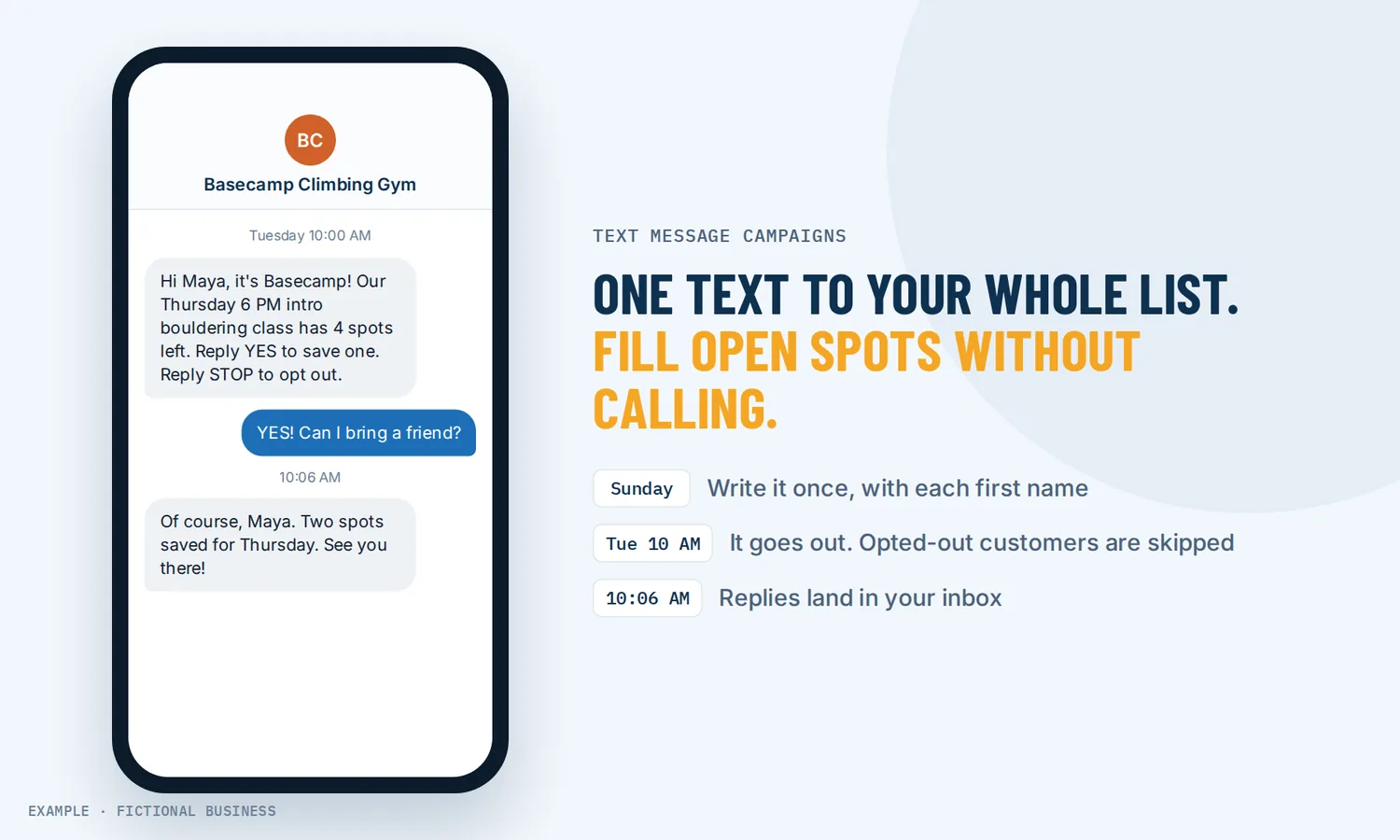
SMS marketing for small business: one text to your whole list, sent when it suits you.
SMS marketing for small business means sending one text message to many customers at once: a sale, an opening in your schedule, a new service, a reminder that it's been a while. Each person gets their own copy, from your business number, and their replies come back to you one by one.
Book a free Revenue Leak Audit
What SMS marketing is and how it works
A text campaign is the list version of business texting. It is not a group chat: nobody sees the other people on the list, and a reply goes only to you.
Here is how it works on the Revenue Growth HQ platform:
- Pick who gets it. Select contacts from your list, or open a saved list such as "customers tagged spring cleanup." Saved lists update themselves as customers change.
- Write the message. Type it or pick a saved template. Add the customer's first name or another field so each text reads like it was written to them. You can add an emoji or a picture.
- Choose the number. Send from your business number. If you have more than one, pick which one the text comes from.
- Choose when. Send now, schedule a date and time, or drip it out in batches: so many texts every so many minutes, hours or days, only on the days and hours you allow.
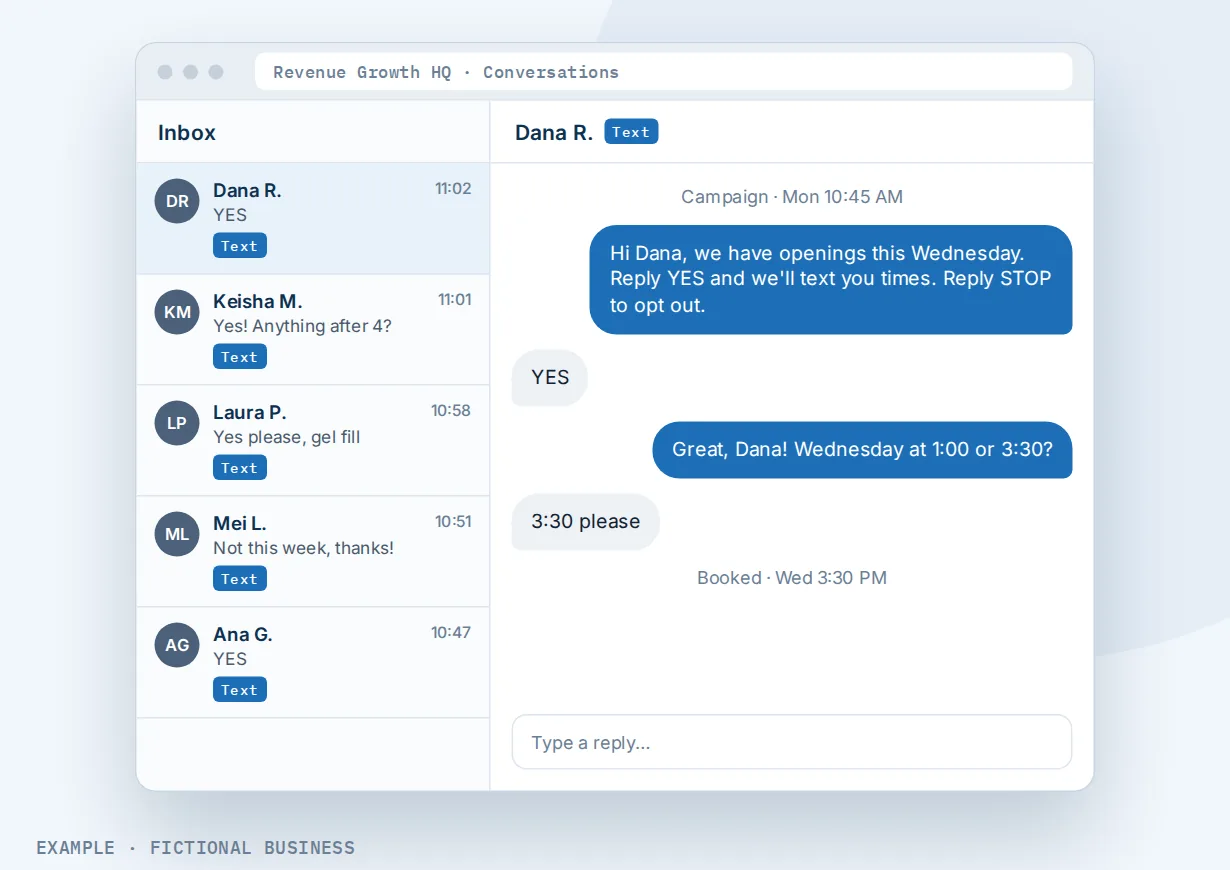
- Watch the results and replies. Each send shows how many texts were sent, delivered, failed or skipped, with the carrier's reason for any failure. Replies land in your inbox on each customer's own thread.
Customers who replied STOP, or who you marked as not to be contacted, are skipped automatically.
What SMS marketing changes for a small business
Reach people where they read
Nearly everyone carries a phone. A 2025 Pew Research Center survey found 98% of U.S. adults own a cellphone and 91% own a smartphone. A text shows up on the lock screen, where a newsletter or a receipt in a crowded inbox does not. That makes text a good fit for short, time-bound news: "Two openings Thursday afternoon," "Our holiday hours," "Last day of the sale."
Fill gaps without making calls
A cancellation or a slow week used to mean calling down a list. A text to the right group does the same job in the time it takes to write two sentences. People who want the slot reply; people who don't, ignore it. You spend your time on the replies, not the dialing.
Send at the right moment
Write a campaign on Sunday night and schedule it for Tuesday at 10 a.m. Drip mode spreads a large list over hours or days, so a sale announcement doesn't bring a flood of replies while you're with a customer.
Messages that connect to the rest of your business
Because the list is your actual customer list, replies sit on each customer's record next to their bookings, invoices and notes. A link in the text can start a follow-up for whoever clicks it, and a reply can start a workflow. With a standalone texting app, you would rebuild that connection by hand or with an integration.
How SMS marketing plays out
A salon with open chairs. Let's suppose you run a salon and two stylists have openings Wednesday. You open your saved list of regular clients and send: "Hi Dana, we have openings this Wednesday. Reply YES and we'll text you times." Replies come into your inbox. Your front desk answers each one and books the time, and every exchange stays on the client's record.
A home service business with a seasonal offer. Let's suppose you service HVAC systems and want to sell fall tune-ups. You have a few thousand past customers, more than you want calling at once. You set the campaign to drip: a batch every hour, weekdays only, between 9 a.m. and 4 p.m. The text includes a tracked booking link. Anyone who clicks it gets tagged and, if they haven't booked within two days, gets one follow-up text from a workflow. The rest of the list hears nothing more.
An online business with a launch. Let's suppose you sell a course or a product online and your buyers are spread across the country. You send an email with the full details to your list, and a short text to the customers who opted in to texts: "The new program opens today. Details are in your email." Customers in western time zones may be hours behind you, so you schedule the text for late morning your time. That way it doesn't reach them before 8 a.m.
What to look for in SMS marketing for small business
Questions to ask before you pick a tool:
- Does it send from your business number, the same one customers already text and call? A separate marketing number splits your conversations.
- Can you pick the list from your real customer records, with saved lists that update themselves, or do you upload and maintain a separate spreadsheet?
- Can you personalize each message with a first name or other field?
- Can you schedule and drip? Sending a large list in batches, within set days and hours, keeps replies manageable and helps you stay inside quiet hours.
- Does it skip people who opted out, and does a STOP reply take effect without you doing anything?
- Where do replies go? Into a shared inbox on each customer's history, or into a separate app someone has to check?
- Can a click or a reply start a follow-up, so interested customers get the next step and everyone else is left alone?
- What does it report? At a minimum: sent, delivered, failed and skipped, with failure reasons.
- How is it billed? Most tools combine a monthly fee with per-message charges. Ask what a reply costs, what a long message or a picture costs, and what the carrier registration fees are.
- Does it help with carrier registration? US carriers require businesses to register before texting from a local number, and the registration has to describe promotional texts if you plan to send them.
If you send one announcement a quarter, a simple tool may be enough. If texts help fill your calendar, reply handling and follow-up matter more than the send button.
SMS marketing works better with automation, AI and your customer list
A campaign is one message. What happens next decides whether it turns into revenue.
Text campaigns plus automatic win-back. A one-time blast reaches everyone on the list today. A win-back sequence for customers who stopped coming does the same job continuously: it groups customers who haven't booked in a while and sends them a check-in or offer automatically, so you're not rebuilding the list every month. Use a campaign for news; use win-back for the steady trickle of customers drifting away.
Text campaigns plus two-way texting and AI replies. A good campaign produces replies, and replies need answers. Every reply arrives as a normal conversation in your business texting inbox, on that customer's thread, where you or your team can answer from the computer or the phone app. A reply can also start a workflow, or be answered by an AI assistant that has been trained on your services and hours. AI use is billed by use, like texts.
Text campaigns plus your CRM. A campaign is only as good as the list behind it. A CRM that keeps each customer's details and tags is what lets you text "everyone who bought a tune-up last fall" instead of everyone at once. Import your existing list from a spreadsheet, record each contact's consent preference on import, and save lists by tag, field or activity so they update themselves.
Text campaigns plus email marketing. Text is good for short, urgent news. Email is better for details, pictures and anything people want to read twice. Email marketing for your list sends to the same saved lists, so you can pair a full email with a two-line text that points to it, and send the text only to customers who agreed to texts.
SMS marketing options: from free to done-for-you
The right choice depends on your list size, how often you send, and whether replies need to connect to the rest of your business.
Your own phone. Free, but not built for this. Group texts show everyone's number to everyone else and turn into reply-all threads, and there's no opt-out handling or record of who agreed to receive texts.
Dedicated SMS marketing apps. These tools are built for list texting: keyword sign-ups, scheduling, reporting. They usually charge a monthly fee plus message credits. The tradeoff is that your list lives in another app, replies arrive somewhere other than your main inbox, and connecting them to bookings and payments takes integrations.
All-in-one platforms. Here, list texting sits in the same system as your contacts, inbox, booking, payments and automation. A reply lands on the customer's record; a click can start follow-up. The tradeoffs: more to set up, and more features than a business that only sends the occasional announcement may want.
Hiring someone. A marketing agency or an assistant can write and send campaigns for you. That saves your time, but you pay for it, and you still need a tool underneath and someone to answer the replies.
Here's our solution
Revenue Growth HQ is an all-in-one platform with text campaigns built in, alongside two-way texting, your customer list, email, booking, payments, automation and AI assistants. The platform is $97 a month. Usage such as text messages, calls, email sending and AI is billed separately, by use, and US texting needs carrier registration with its own one-time and monthly fees. You see the rates before setup. Setup is priced by how much you want done: we can set up your number, registration, saved lists and follow-up for you, or show you how and let you do more of it yourself.
The first step is a free 20-minute Revenue Leak Audit.
Limits to know
- Consent is your responsibility. The platform skips customers who opted out. Making sure everyone else on the list agreed to marketing texts, and keeping a record of it, is up to you.
- No marketing texts until registration is approved, and the registration has to say you will send promotional messages.
- New accounts start with a daily cap that rises as you send. A large list may need drip mode over several days at first.
- Sending hours follow your account's time zone, not each customer's. Plan around the earliest and latest time zones on your list.
- A sent text can't be recalled. You can pause or cancel a scheduled or drip send, but texts that already went out stay sent.
- Every text costs money, including replies, and long messages and pictures cost more than a short plain text.
SMS marketing features included
- One text to many contacts, each sent separately
- Send from your business number
- Pick recipients from your contact list or a saved list
- Saved lists that update themselves by tag, field or activity
- First name and other fields in the message
- Saved message templates
- Emoji and picture messages
- Send now, at a scheduled time, or in drip batches
- Drip settings: batch size, interval, send days and sending hours
- Opted-out contacts skipped automatically
- STOP replies turn off texts for that contact
- Sent, delivered, failed and skipped counts, with failure reasons
- Pause, reschedule or cancel a queued send
- Replies in the shared inbox and the mobile app
- Tracked links and replies that start follow-up workflows
Frequently asked questions
What is SMS marketing for small business?
It is sending a text message to a group of customers at once, usually to share an offer, an opening, an event or news. Each customer gets their own message and can reply privately. It differs from one-to-one business texting, which is conversation, and it comes with stricter consent rules because the messages are promotional.
Do I need permission to send marketing texts?
Usually, yes. Federal rules require prior express written consent for marketing texts sent to cell phones with an autodialer, and that consent can't be a condition of buying from you. People who get texts without it can sue for a set amount per violation, and a court can triple it if the violation was willful. A customer texting you a question is not the same as a signed agreement to receive promotions. Check with a lawyer about your own list; this isn't legal advice.
What time of day can I send marketing texts?
Federal rules bar telephone solicitations before 8 a.m. or after 9 p.m. in the recipient's local time. Schedule campaigns inside those hours with room to spare, and remember that drip sending hours follow your account's time zone, not each customer's. For a national list, aim for late morning to mid-afternoon your time.
What happens if someone replies STOP?
Their texts are switched off. A reply such as STOP or UNSUBSCRIBE marks that customer as not to be texted, and later campaigns skip them. In most cases texting starts again only if they text START. Say how to opt out in your first message.
How much does SMS marketing cost?
Most tools charge a monthly fee plus a charge per message. On Revenue Growth HQ, text campaigns are included in the $97-a-month platform; each text sent and each reply received is billed by use, and US texting needs carrier registration with a one-time and a monthly fee. Long messages and pictures cost more than a short plain text. You see the rates before setup.
Can I send a text to all my customers at once?
Yes, as long as they agreed to receive texts. Select everyone, or a saved list, and send now or schedule it. For a large list, drip mode sends it in batches over hours or days so replies come in at a pace you can answer. New accounts have a daily cap that rises as you send, which is another reason to drip a big list.
Ready to turn your customer list into booked work?
Book a free 20-minute Revenue Leak Audit. We'll look at how you reach past customers today and what a text campaign would add.
Sources
- Pew Research Center. "Mobile Fact Sheet." Survey conducted February to June 2025. https://www.pewresearch.org/internet/fact-sheet/mobile/ (checked 2026-10-18)
- 47 CFR 64.1200, "Delivery restrictions." Legal Information Institute, Cornell Law School. https://www.law.cornell.edu/cfr/text/47/64.1200 (checked 2026-10-18)
- 47 U.S.C. 227, "Restrictions on use of telephone equipment." Legal Information Institute, Cornell Law School. https://www.law.cornell.edu/uscode/text/47/227 (checked 2026-10-18)